Why ChatGPT Recommends Your Competitors But Not You (And How to Fix It in 90 Days)
AI recommends your competitor instead of your product for a structural reason — not a quality one. Here is the framework to fix it.
· P-GEO · 9 min read
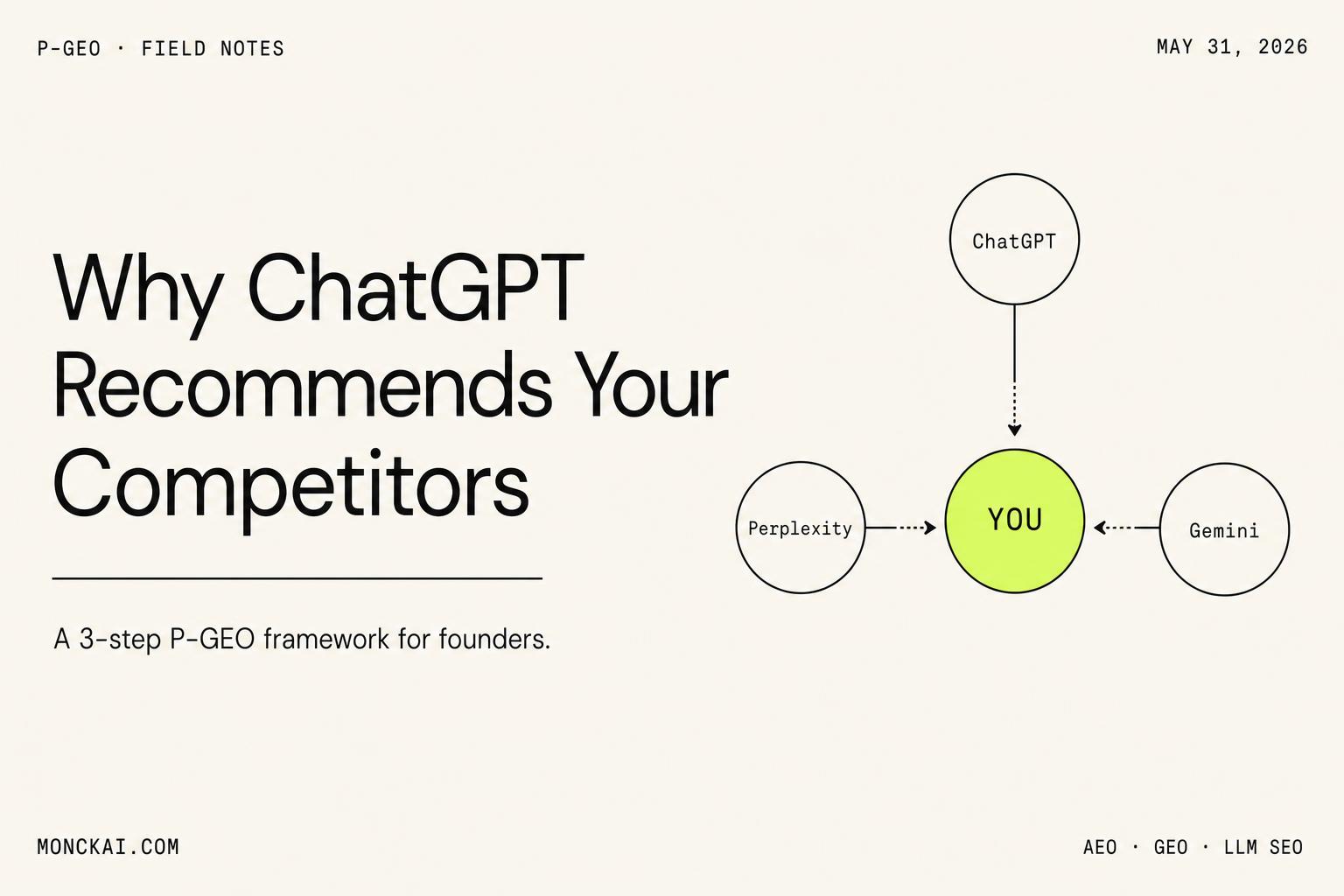
The uncomfortable truth: 40% of B2B leads now come through AI recommendations. If ChatGPT doesn't know you exist, you're losing deals before they even start.
Why AI Systems Skip Most Founders — Even the Successful Ones
You have real revenue. Real traction. Real results. But when a prospect asks ChatGPT "Which B2B SaaS founders should I follow?" your name doesn't come up. Your competitors show up instead — founders with less experience, fewer results, and smaller businesses than yours.
This isn't because ChatGPT has bad taste. It's because ChatGPT doesn't have enough authoritative third-party sources pointing to you as an expert. Your website alone won't cut it. Your LinkedIn posts alone won't cut it. You need a system.
We call this P-GEO — Personal Generative Engine Optimization. It is the discipline of engineering your way into the small pool of names that AI engines retrieve, re-rank, and quote at answer time. In this guide, I'll show you exactly how it works and why 100+ B2B SaaS founders are using it to get cited by ChatGPT, Perplexity, and Google AI.
Here is the structural problem. AI systems do not build their knowledge from your own website. They build it from third-party sources — publications, podcast transcripts, founder roundups, structured profile pages, indexed LinkedIn threads, and Wikipedia-grade reference pages. Your owned media is a confirmation signal at best. It is never the primary citation source.
That is why Google SEO and AI visibility are completely different games. Google SEO rewards the page that ranks. AI visibility rewards the entity that gets quoted. A founder with a top-ranked About page and zero third-party authority will still lose every ChatGPT answer to a founder who has been quoted in five publications.
Traditional personal branding falls flat for the same reason. Posting daily on LinkedIn builds an audience. It does not build citation density. Vanity metrics — followers, likes, impressions — are invisible to retrieval systems. What is visible is whether your name shows up next to a topic across multiple independent, high-authority sources.
- Founder A: Rs 1Cr revenue, daily LinkedIn posts, zero AI citations per month.
- Founder B: Rs 30L revenue, three published guest essays + two podcast appearances, cited in 15 ChatGPT answers per month.
- Same category. Same audience. Completely different AI standing.
What it costs to be invisible to AI
Lost deals from buyers who short-listed your competitors after a single ChatGPT query. Missed funding because the partner did a Perplexity check before the call. Zero inbound from operators who asked Gemini "who should I learn from in this category?" and never saw your name.
Every week you stay invisible is a week your competitors compound their citation density. AI rankings are not a leaderboard you can sprint up. They are a slow flywheel — which is exactly why the founders who start now win the next 24 months.
The 3 Things ChatGPT, Perplexity, and Google AI Look For
Before you can engineer your way in, you need to understand what the retrieval layer actually rewards. Across every major AI engine, three signals dominate. Get all three right and you start appearing in answers. Miss any one and you stay invisible — no matter how good your work is.
1. Third-Party Authority
AI engines pull from trusted external sources: publications, reviews, case studies, podcast transcripts, community mentions, and structured profile pages. They weight independent sources more heavily than owned ones because independent sources are harder to fake.
When someone asks ChatGPT how to build a personal brand as a B2B SaaS founder, it looks for authoritative sources on that topic. If you're mentioned in 10+ publications that answer this question, ChatGPT is more likely to cite you. If you are only mentioned on your own website, you are functionally invisible.
The threshold is lower than founders think. You do not need 100 features. You need 8 to 12 high-quality, topic-aligned mentions across publications that AI engines already trust.
2. Semantic Clarity
AI engines need to understand three things about you in one sentence: what you do, who you serve, and what problem you solve. If your positioning takes a paragraph to explain, retrieval systems pick a clearer competitor.
Semantic clarity is the difference between "I help founders grow" (invisible) and "I help B2B SaaS founders go from invisible to Series A-ready" (citable). The second version gives the engine a clean entity-topic match it can quote with confidence.
3. Consistency Across Platforms
AI cross-checks information across sources to verify credibility. If your LinkedIn says you help B2B SaaS founders but your website says you help e-commerce entrepreneurs and your podcast bio says you help "ambitious builders," the engine gets confused and moves on to a founder whose story matches across every surface.
Consistency is the cheapest signal to fix and the one most founders ignore. A single afternoon of rewriting bios across LinkedIn, your website, Twitter, podcast intros, and conference profiles raises your retrieval confidence more than another month of posting.
The P-GEO Framework: How to Become the Founder ChatGPT Recommends
The framework is three steps, executed in this order. Skipping ahead is the most common mistake. Authority without semantic clarity wastes mentions. Semantic clarity without citable content gives the engine nothing to quote. Citable content without third-party authority sits on your site and never gets indexed into the retrieval pool.
Step 1: Build Third-Party Authority
Get featured in 1–2 founder-focused publications per quarter (SaaStr, TechCrunch, First Round Review, Product Hunt, etc.). Get quoted by journalists covering the founder space. Get listed in "best B2B SaaS founders to follow" roundups. Create original research — a small survey, a category benchmark, a teardown — that other people want to reference.
Specific tactic: Reach out to 10 journalists covering the B2B SaaS space. Offer to be a source for their stories — not to pitch yourself, but to genuinely help with context, numbers, and quotes on deadline. Reporters remember the founder who answered fast with one usable line. That single relationship turns into three mentions over six months.
Step 2: Clean Up Your Digital Footprint
Consistent messaging across LinkedIn, your website, Twitter, podcast bios, and conference profiles. Clear positioning written for entity-topic match: "I help B2B SaaS founders go from invisible to Series A-ready." Schema markup on your website (Person, Organization, Article) so AI can parse what you do without guessing. An FAQ section that answers real founder questions in the exact language buyers use.
Specific tactic: Audit your LinkedIn, website, and Twitter in one sitting. Open all three side-by-side. Do they say the same thing about what you do, who you serve, and what problem you solve? If not, rewrite the headline, the bio, and the meta description until they match. This single fix moves more founders into AI answers than any other.
Step 3: Create Content People Actually Cite
Most founder content is not citable. It is opinion without data, motivation without method, or news without a fresh angle. Citable content has one trait: someone else can quote a single sentence from it and the sentence still works.
Build a small catalogue of citable assets: case studies with real numbers ("Helped a founder go from 0 to 15 AI citations per month"), comparison pieces ("Founder personal branding vs corporate branding"), original data ("Survey of 500 B2B SaaS founders shows…"), and method guides ("The 3-step system to build AI authority").
Specific tactic: Publish one case study per month. Make it specific, data-driven, and easy to reference. Anchor every claim to a number, a timeline, and a named outcome. Journalists, podcasters, and AI engines all reward the same thing — a clean fact they can lift without doing extra work.
Case Study: From 0 AI Citations to 15 Per Month in 90 Days
Starting point: a founder running a Rs 1.5Cr revenue B2B SaaS analytics tool. Strong product, loyal customers, zero AI mentions across ChatGPT, Perplexity, Gemini, or Claude. Daily LinkedIn posts, decent following, no inbound from AI-influenced buyers.
What changed: we ran the P-GEO framework end to end. Step 1 — placed two guest essays in B2B-SaaS-focused publications, secured three podcast appearances, and seeded one piece of original research (a 200-founder benchmark on B2B SaaS retention). Step 2 — rewrote every bio across LinkedIn, the company About page, podcast intros, and a refreshed Crunchbase profile to match a single positioning line. Step 3 — published three case studies and one comparison guide, all with named numbers and named outcomes.
Results at 90 days: 15 AI citations per month tracked across the four major engines, 5 inbound conversations per month directly attributed to AI recommendations (asked at discovery: "how did you hear about us?"), and one Series A investor reaching out after a Perplexity search returned the founder's name three times on a single query.
The specific tactics that moved the needle the most were the original research piece (it got referenced in seven follow-on articles within 60 days) and the bio cleanup (it lifted retrieval confidence across every engine simultaneously). The case studies compounded slowly — they did not drive citations in month one, but by month three they were the most quoted assets.
5 Mistakes That Keep Founders Invisible to AI
Every founder we audit makes at least three of these. Fix them in order — they compound.
- Inconsistent Messaging — your LinkedIn says one thing, your website says another, and your podcast bio says a third. Retrieval systems can't pick a winner, so they pick someone else.
- No Third-Party Authority — you only promote yourself, never get mentioned elsewhere. Owned media is a confirmation signal, not a citation source.
- Generic Positioning — "I help founders" instead of "I help B2B SaaS founders go from invisible to Series A-ready." Generic positioning is invisible to entity-topic matching.
- Nothing Worth Citing — you post frequently but create nothing that others actually reference. High volume, zero citable assets.
- Ignoring AI Visibility — you focus on Google SEO and Instagram while the real game has moved. The buyers you want are asking ChatGPT first now.
How to Start Getting Cited by AI This Week
You don't need a 90-day plan to start. You need five concrete actions this week. Do them in order and you'll see the first signals — retrieval confidence lifting, a citation appearing on a long-tail query — within 30 days.
- Audit your current AI visibility (take the free MONCKAI audit and see exactly where you stand across ChatGPT, Perplexity, Gemini, and Claude).
- Pick 1–2 publications to pitch for features in the next 30 days. Lead with a specific angle, not a generic introduction.
- Write your first case study — one founder, real numbers, named outcome, under 1,500 words.
- Clean up your website for semantic clarity. Rewrite the homepage hero, the About page, and every meta description against a single positioning line.
- Set up weekly tracking of AI citations across the four major engines so you can see the flywheel turn before it shows up in revenue.
Frequently Asked Questions
Why does ChatGPT recommend my competitors instead of me?
Because they have higher third-party citation density on the topics your buyers ask about. ChatGPT retrieves and re-ranks a small pool of high-authority sources — if your name is not embedded in those sources, you are absent, not penalised. Fix it by building independent mentions, semantic clarity, and citable content.
How long does it take to start showing up in AI answers?
First citations typically appear within 30 days of consistent execution on the P-GEO framework. Meaningful inbound — 5+ AI-attributed conversations per month — usually lands at the 90-day mark.
Is AI visibility different from Google SEO?
Yes. Google SEO rewards the page that ranks. AI visibility rewards the entity that gets quoted. They share some underlying signals (authority, clarity, consistency) but the retrieval mechanics and the winning assets are different.
What is P-GEO?
Personal Generative Engine Optimization. It is the discipline of engineering your way into the small pool of names that ChatGPT, Perplexity, Gemini, and Claude retrieve and quote at answer time.
Do LinkedIn followers help with AI visibility?
Directly, no. Followers are a vanity metric AI engines don't see. Indirectly, yes — a larger audience makes it easier to land podcast appearances, guest essays, and journalist relationships, which are the signals that do move retrieval.